Are current age verification processes preventing underage vaping?
Age verification in the UK and U.S. continues to rely on inspecting
photo IDs of potential purchasers in retail environments, while
ecommerce stores are mandated to implement age verification systems.
This can require users to upload a government-issued ID or use credit
card verification to complete a purchase which means checks can easily
be bypassed.
“Responsible retailers, who are valuable members and contributors to
their communities, would never sell to underage users. However, even
with robust staff training and vigilance, mistakes can still be made.
Technology which also puts the onus on the user to verify age rather
than solely us, the retailers, would be a real help for retailers in
eliminating youth use.”
—Atul Sodha, award-winning UK-based retailer
76%
believe young people are buying vapes online with minimal or no age verification
71%
think they’re doing so from retail shops without being asked for ID
Looking at age verification methods aimed at preventing underage people
from buying vapes in stores and online:
62%
say they’re easy to bypass
66%
young people are more likely to believe they’re easy to bypass
“Legacy age verification methods, dependent on stored personal data,
physical IDs, or clunky user flows, have failed to protect both privacy
and minors. These systems are easily circumvented by fake credentials or
proxy purchases, while users are forced to sacrifice privacy for access.
Until we deliver verification that is both secure and seamless, we risk
failing on both fronts. It’s time to raise the standard and move beyond
outdated models.”
—Thomas Chen, Partner at IKE Tech
Technology solutions must revolutionize age verification
“Just recently, I’ve been pleased to learn of new technical solutions
which could help government end youth vaping. Current laws require age
verification at the point of sale, something which has fundamentally
failed to stop young people from getting hold of vapes. Government could
go further and require continuous age verification at the point of use.”
—Mary Glindon, UK MP
While current age verification methods are widely viewed as easy to
bypass, survey respondents believe that real-time identity verification,
like biometrics or digital IDs, could significantly strengthen
safeguards, especially against underage access:
70%
rated these measures as helpful for stopping underage use
69%
for preventing misuse
60%
for preventing theft
Our survey respondents believe a combination of technology solutions
could help prevent underage access to vaping products:
50%
point of use age verification (a digital child lock - biometric identification or similar that must be passed to unlock a device)
49%
point of sale digital age verification (i.e., ID scanning and real-time verification)
24%
smartphone-based access control (devices must be paired with a verified adults app via Bluetooth® or similar)
54%
of young people (aged 15-17) see point of use age verification as the top tech to prevent underage vaping
New innovations: The power of point of use age verification
“Vapes on sale in the UK market could be required to have a secure
Bluetooth® technology installed, a low-cost chip that can be integrated.
These chips provide a simple on-off switch that can be controlled via a
mobile app. Users would then have to verify their image via the app in
the same way as happens when accessing other services. This simple and
straightforward approach would mean that no matter how a child got hold
of a vape, they will be unable to use it. As this process would be quick
and user-friendly, it would not prevent adult vapers from using these
products as they currently do.”
—Mary Glindon, UK MP
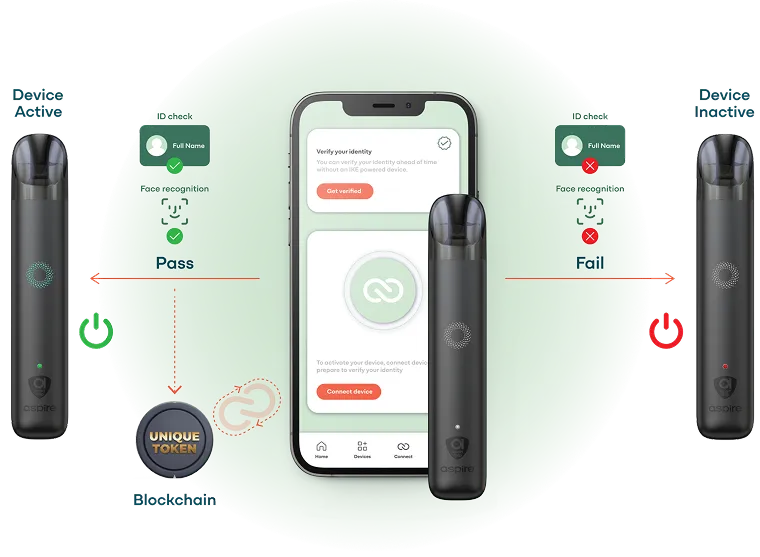
Features built into vapes to block underage use and illicit sales can be
as strict or flexible as a local government requires. Blockchain-based
point of use age verification technology can ensure that only verified
adults use ENDS (electronic, e-cigarettes, vaping devices, or vape pens)
not just at the point of purchase, but also at the point of use, again
depending on what the local government requires. Using a mobile app,
users scan their government-issued ID and complete a biometric check
(like a selfie), which pairs their verified identity with the device via
Bluetooth®.
Devices then can remain locked and only be turned on and used if the
user has been securely verified via the app and is within close
proximity to their mobile device. If set up accordingly, when devices
travel outside of Bluetooth® range and reconnect, or if they enter an
idle state after a predefined period of inactivity, the user can be
required to reactivate it via a selfie.This can make it much harder to
bypass than traditional retail age checks. All verification data is
securely tokenized and recorded on a blockchain, ensuring privacy (no
personal data or raw biometrics are stored) and creating a tamper-proof
audit trail for regulatory compliance.
The Aspire products shown are owned by their Brand
Owner, Shenzhen Eigate Technology Co., Ltd. IKE Tech provides the
verification and authentication technology.
“Security should never come at the expense of user experience. If age
verification isn’t seamless and as frictionless as possible, we drive
consumers – and especially youth - straight back to the black market.”
—Jason Carignan, Chief Commercial Officer, IKE Tech
Further use-cases: Preventing illicit market sales and restoring public
confidence
Looking at other use cases for this new technology beyond age
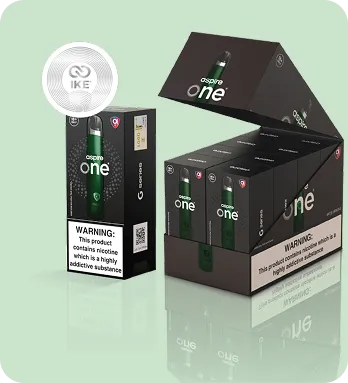
verification, tamper-proof NFC/RFID smart tags on each product package
ensure authenticity and traceability. Each tag is trackable using secure
tokens and recorded on a blockchain, helping to eliminate illicit market
devices by making it very clear when a device is legitimate. The IKE
Tech Smart Tag utilizes Near Field Communication (NFC) technology only
and does not incorporate Bluetooth® technology.
Technology also is available that can support geo-fencing for sensitive
areas to further protect users and support public health goals.
Bringing all these innovations together forms a seamless, scalable
framework, enhancing security, ensuring compliance, and fostering
consumer trust. IKE Tech’s age gating solution is the first FDA-submitted, scalable solution of its kind and is helping
effectively address youth vaping, restore public confidence, and is building
a foundation of trust and safety across industry and society, helping protect
the next generation. Notably, a recent Human Factors validation study unveiled 100% effectiveness in age-gating
with IKE's Bluetooth® Low Energy chip.
The Aspire products shown are owned by their Brand Owner, Shenzhen Eigate Technology Co., Ltd. IKE Tech provides the verification and authentication technology.
“Anonymous, secure, and frictionless, IKE Tech brings trust back to
age verification at every touchpoint. Brands, regulators, and
consumers no longer need to compromise between privacy and
protection.”
—Thomas Chen, Partner at IKE Tech
While this technology will be transformative in reducing underage
vaping, it’s important to remember that it will take more than
technology to solve this challenge.
“Age verification isn’t a silver bullet – real progress happens when
the government, industry, and retailers unite.”
—Jason Carignan, Chief Commercial Officer at IKE Tech
85%
of respondents who currently vape would purchase devices with point of use age verification tech if they knew it helped stop underage vaping
78%
of all respondents would support point of use age verification for vapes if they knew it genuinely blocks underage usage
The proprietary data referenced in this whitepaper was sourced from an
online survey of 5,000 respondents: 2,000 UK adults; 2,000 U.S. adults;
500 UK children aged 15-17 via their parents; and 500 U.S. children aged
15-17 via their parents. It was commissioned by Clarity Global on behalf
of IKE Technology and conducted by market research company OnePoll,
following the Market Research Society's code of conduct. Data was
collected between the 3 June 2025 and 10 June 2025. OnePoll are MRS
Company Partners, corporate membership of ESOMAR and Members of the
British Polling Council.
Next: Vaping 2030: A Vision For The Next Five Years